
Golfer’s Elbow (Medial Epicondylitis)
What Is Golfer’s Elbow?
Golfer’s Elbow, or medial epicondylitis, is an overuse injury involving the flexor tendons that attach to the medial epicondyle — the bony bump on the inside of the elbow. It’s caused by repetitive stress or strain on the tendons that help you grip, twist, and flex the wrist and fingers.
This condition doesn’t just affect golfers — it’s also common in individuals who perform repeated gripping, lifting, or wrist flexion tasks at work or during recreational activities.
Book A Consultation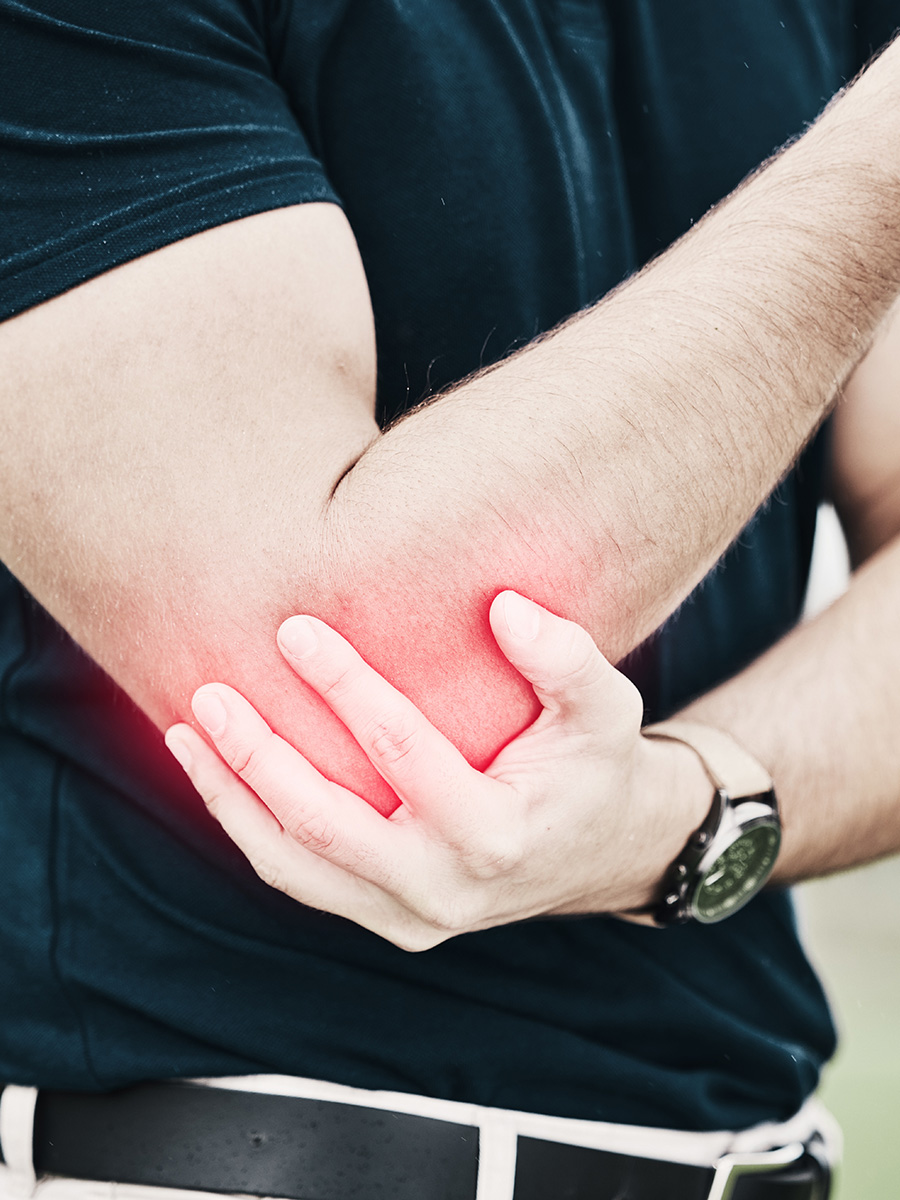

Causes and Risk Factors
- Repetitive wrist flexion, gripping, or forearm rotation
- Sports involving throwing, swinging, or climbing
- Jobs requiring manual labor (e.g., carpentry, plumbing, assembly line work)
- Poor ergonomics or technique during repetitive tasks
- More frequent in adults aged 35–50 years
Common Symptoms
- Pain or tenderness on the inner side of the elbow
- Pain that radiates down the forearm
- Weakened grip strength
- Stiffness or discomfort when flexing the wrist or turning the palm downward
- Worsening symptoms with lifting, throwing, or twisting motions
Diagnosis
Diagnosis is usually based on history and physical examination:
-
Tenderness over the medial epicondyle
Pain reproduced with resisted wrist flexion or pronation
Imaging (MRI or ultrasound) may be used to evaluate chronic or severe tendon damage
Treatment Options
Non-Surgical Management
Most patients recover without surgery:
- Activity modification to avoid aggravating movements
- Anti-inflammatory medications (NSAIDs)
- Ice therapy to reduce inflammation
- Forearm braces or counterforce straps
- Physical therapy to improve:
- Flexor tendon strength
- Range of motion
- Biomechanics
- Corticosteroid injections for pain relief
- Platelet-rich plasma (PRP) therapy for chronic cases
Surgical Treatment
Surgery is considered when:
- Symptoms persist after 6–12 months of conservative treatment
- Daily activities or athletic performance are significantly impaired
Surgical procedures typically involve:
- Removal of degenerative tendon tissue
- Reattachment of healthy tendon to the medial epicondyle
- Can be done via open or minimally invasive techniques
Recovery Outlook
- Non-surgical care: Most recover within 8–12 weeks
- Post-surgical recovery: 3–6 months depending on activity demands
- Physical therapy is critical for regaining strength and preventing recurrence
Comprehensive Care at Kerlan Jobe Institute
At Kerlan Jobe Institute, we provide advanced diagnostic tools and a full range of non-surgical and surgical treatments for Golfer’s Elbow. Our orthopedic and sports medicine specialists tailor your treatment plan to get you back to your sport, job, or hobby as safely and efficiently as possible.
Getting You Back in Motion
Surgery is just the beginning. How do you heal, move, and feel when all is said and done?
From NHL and NBA players to weekend warriors, our goal is the same: getting you back to doing what you love.
Patient Testimonials
highly skilled surgeon
“Dr. Kvitne operated on my shoulder 3 years ago and I had a perfect recovery and no problems since and I do not see a scar. He is kind with a great bedside manor and a highly skilled surgeon.”
Dr. Kharrazi truly got me back on my feet—literally.
One year ago, I tore several ligaments in my knee, and now I’m able to do the things I enjoy again.
His expertise, knowledge, and confidence are what made me choose him as my surgeon, and I will always be grateful to him and his entire team. Rudy, his assistant; Norma, who was always so prompt with all of my emails; and Blanca, who helped with forms—each of them made a difference. I can’t thank them enough for being there with me every step of the way.
I can’t say enough good things about Dr. Kvitne
“My experience with Dr Kvitne was amazing he is a outstanding Doctor what a talented man he is my knee was in such bad shape he did not have much to work with but he got in there and fixed me up there was so much that had to be repaired Dr Kvitne with his knowledge and experience repaired my knee so nicely done I have had knee surgery before but never like this I can’t say enough good things about Dr Kvitne awesome human being as well as a awesome excellent Doctor!!”
Dr. Kharrazi gave me my mobility back
After 2 knee surgeries with other Orthopedics I must say that Dr. Kharrazi is a miracle worker. I have my mobility back and my pain level is so greatly improved. Thanks Dr. K!
Schedule a Consultation
Kerlan-Jobe provides comprehensive orthopaedic care for patients seeking expert treatment for sports injuries, joint pain, and mobility limitations. We offers specialized experience and a patient-first approach designed to support lasting results.
Contact the office to schedule a consultation and learn more about your treatment options.