ACL Tears
Causes, Symptoms, and Treatment Options
What Is an ACL Tear?
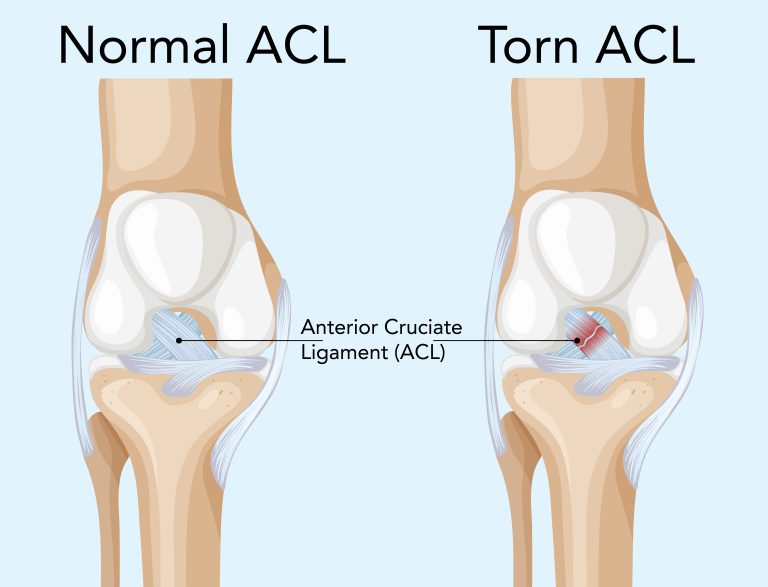
The anterior cruciate ligament (ACL) is one of the four key ligaments in the knee that help stabilize the joint. Located in the center of the knee, it connects the femur (thigh bone) to the tibia (shin bone), playing a critical role in preventing the tibia from sliding forward relative to the femur. The ACL also assists in maintaining rotational stability during pivoting movements.
An ACL tear occurs when the ligament is stretched or torn beyond its structural limit, often resulting in a partial or complete rupture. These injuries are especially common in athletes and physically active individuals.
How Do ACL Tears Happen?
Contrary to popular belief, most ACL tears are not caused by direct collisions or contact. In fact, about 70–80% occur through non-contact mechanisms, typically during movements like:
Rapid deceleration
Sudden changes in direction
Pivoting or twisting
Landing awkwardly from a jump
These injuries are frequently seen in sports such as soccer, football, basketball, skiing, volleyball, and gymnastics. Female athletes have a higher risk—studies suggest up to three to five times more likely—due to a combination of anatomical, hormonal, and biomechanical factors.
Common Symptoms of an ACL Tear
Individuals who tear their ACL often describe a distinct “popping” sound or sensation at the time of injury, followed by:
Sudden, intense pain
Rapid swelling within hours
Difficulty bearing weight or walking
Instability or “giving way” of the knee
Loss of full range of motion
Inability to continue athletic activity
Prompt evaluation and imaging (usually MRI) are essential to confirm the diagnosis and assess any related injuries to the meniscus, cartilage, or other ligaments.
Can ACL Tears Be Prevented?
While no injury is 100% preventable, structured neuromuscular training programs can significantly reduce ACL injury risk. These programs focus on:
Enhancing strength and coordination of the hips, quads, hamstrings, and core
Teaching proper landing mechanics and pivot techniques
Improving proprioception and joint awareness
Encouraging safer movement patterns during sports
At Kerlan Jobe Institute, we emphasize whole-body biomechanics and long-term injury prevention—not just treatment of the torn ACL.
ACL Re-Injury: Understanding the Risks
After an initial ACL injury, the risk of a second tear—either in the repaired knee or the opposite one—is significantly increased, especially within the first two years post-surgery.
Factors that influence re-injury risk include:
Graft placement and surgical technique
Returning to sport too early
Incomplete rehabilitation
Failure to address associated injuries (e.g., meniscus, collateral ligaments)
Biomechanical imbalances
Lack of psychological readiness
Our team of knee specialists performs a high volume of successful ACL reconstructions annually and takes a comprehensive approach to reduce re-injury risk, including return-to-play testing, bracing (if appropriate), and long-term strength programming.
Treatment Options for ACL Tears
Treatment depends on the severity of the tear, patient age, activity level, and associated damage.
Non-Surgical Management:
Partial ACL tears or tears in less active individuals may be managed with:
Physical therapy
Bracing
Activity modification
However, most complete tears in active patients require surgery for full joint stability.
Surgical Reconstruction:
ACL reconstruction involves replacing the torn ligament with a graft, commonly from:
The patient’s own hamstring or patellar tendon (autograft)
A donor tendon (allograft)
Our surgeons at Kerlan Jobe Institute use advanced arthroscopic techniques and individualized graft selection to restore knee function with precision.
Recovery Timeline After ACL Surgery
Recovery is a gradual, multi-phase process. Here’s what patients can expect:
Days 1–5: Rest, swelling control, and light movement
Weeks 1–6: Begin physical therapy with focus on range of motion and gentle strength
Weeks 6–12: Weight-bearing exercises and foundational strengthening
Months 3–6: Functional training, agility, and sports-specific conditioning
Months 6–9+: Return-to-sport testing and gradual reintegration to high-impact activities
Return to full sports participation usually occurs around 6–9 months, but always depends on meeting objective strength, stability, and confidence benchmarks—not just time.
Why Choose Kerlan Jobe Institute for ACL Care?
At Kerlan Jobe Institute, we don’t just repair ACLs—we restore careers, confidence, and quality of life. Our fellowship-trained surgeons are nationally recognized in sports medicine and knee reconstruction. We combine surgical precision, cutting-edge rehab strategies, and personalized care plans to give every patient the best chance at a full recovery.